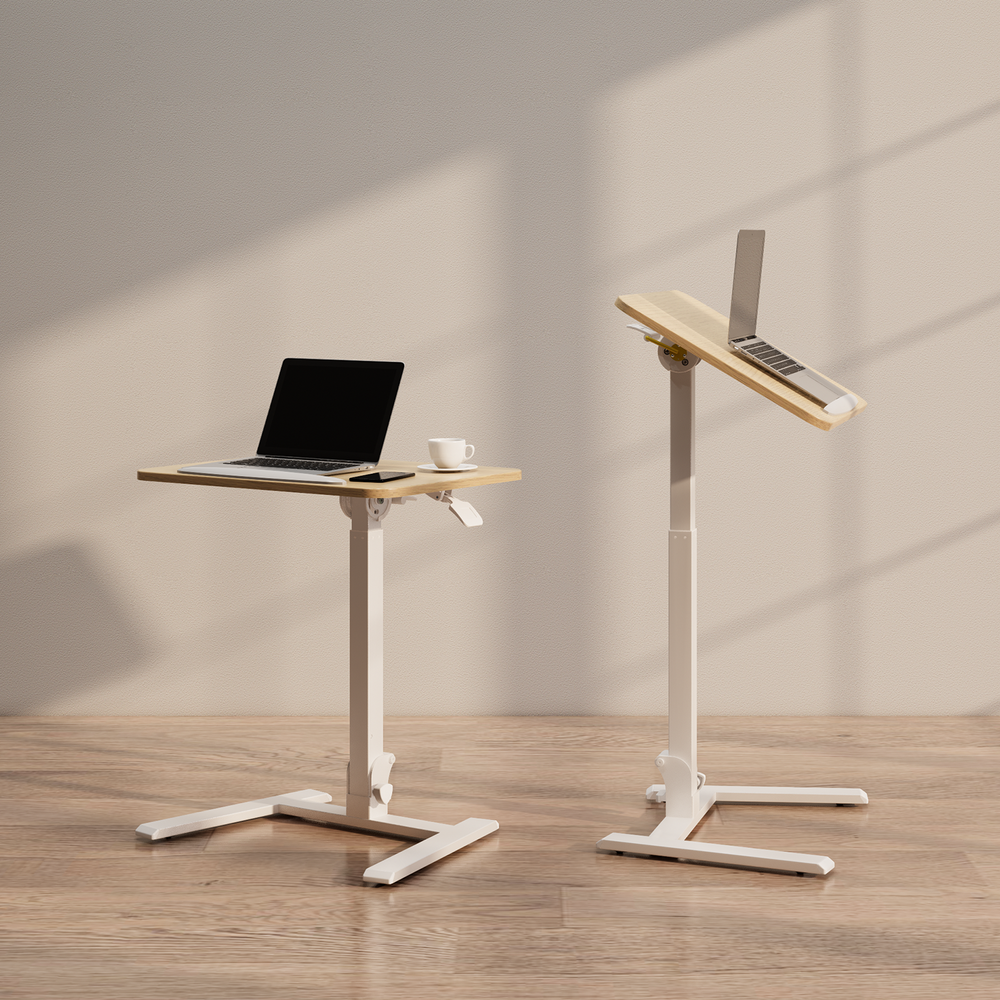
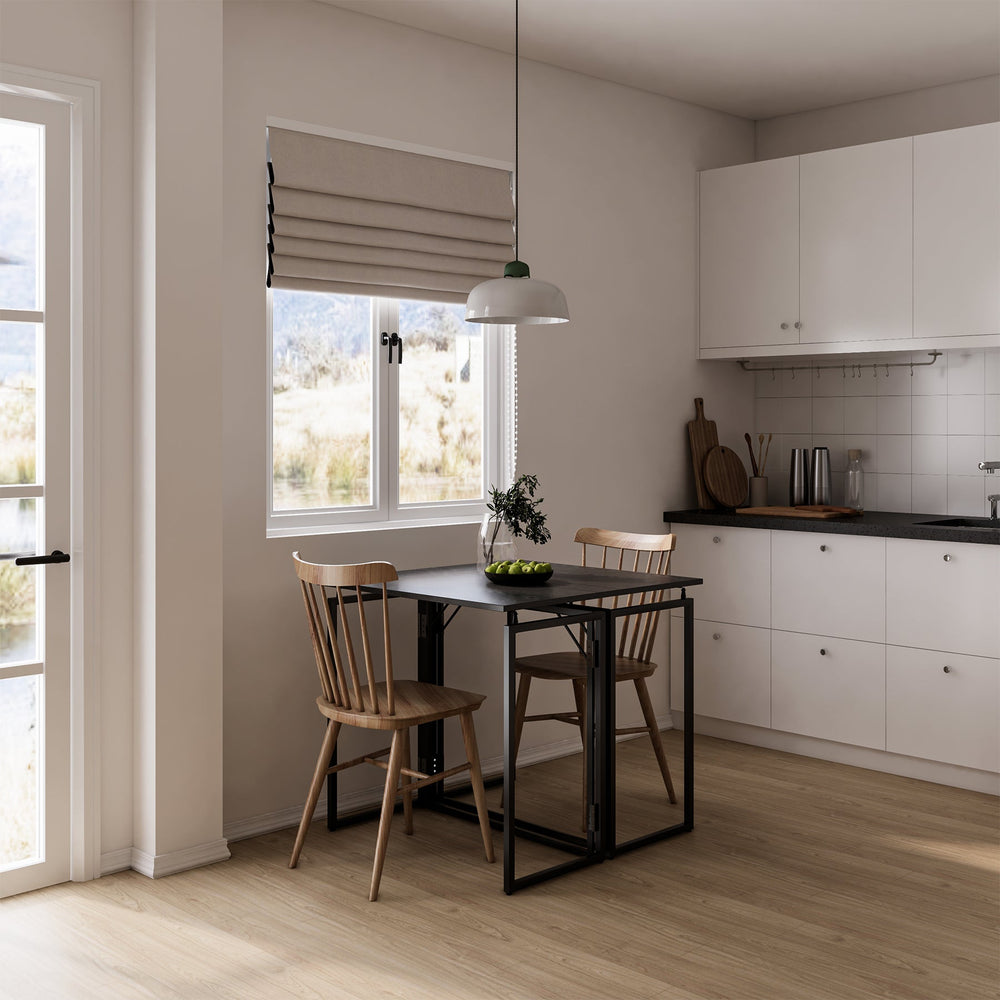
A tabletop can look right for your room while leaving important questions unanswered. Does “wood” describe the material or its appearance? Is a brown finish solid wood? Does a metal frame make the desk suitable for a monitor arm?
Start with the written material description for the exact model. Alawooder’s two fixed-height folding desks list engineered wood tabletops with metal legs. The Mobile Folding Desk lists an engineered wood tabletop and an alloy steel base. Those descriptions are useful, but they do not establish every detail about the top or every compatible accessory.
Separate the material, finish and color
A listing may use several words to describe one surface. Keep them in separate fields instead of allowing a color name or wood-grain photograph to fill in missing construction information.
| Listing field | What it helps identify | What it does not prove alone |
|---|---|---|
| Material | The stated tabletop construction, such as engineered wood | The exact substrate, every layer or accessory compatibility |
| Surface finish | The described outer surface or treatment | A particular scratch, water or heat-resistance rating |
| Color or wood-look name | The appearance offered for a variant | Solid wood construction or a named timber species |
The EPA’s consumer FAQ describes composite wood as wood components joined using adhesives, and identifies examples including hardwood plywood, MDF and particleboard. A broad engineered-wood label does not identify which construction a particular desk uses.
This explanation is not a claim that an Alawooder tabletop uses a specific substrate or holds a particular certification. If the substrate, surface layer or material documentation matters to your purchase, ask for information tied to the exact model and variant.
Check material and dimensions separately
The three desks have different tabletop sizes even where a material category is shared. The fixed 30-Inch model lists a 31.5 × 15.7-inch tabletop; the fixed 40-Inch model lists 39.4 × 19.7 inches. The Mobile model lists 25.6 × 18.9 inches.
Measure the equipment you use at the same time and compare its layout with the actual surface dimensions. The names 30-inch and 40-inch are model labels, not exact measured tabletop widths. A larger surface also does not, by itself, establish a greater load allowance or a different tabletop thickness.
The desk comparison brings together the size and feature information. Use that page for model choice, and keep material-specific questions with the exact product you are considering.
Ask about monitor-arm mounting before buying an arm
“Engineered wood” is not enough information to confirm a clamp-mounted or through-top monitor arm. The arm’s manufacturer may specify requirements which the desk listing does not address.
Before choosing an arm, collect the arm model, monitor details and its mounting requirements. Then ask the desk supplier for the matching measurements and whether that mounting method is permitted.
- Tabletop thickness: the measurement at the proposed mounting location.
- Edge shape: whether the proposed clamp position has a suitable surface and profile.
- Under-top clearance: the available space where the lower mounting part would sit.
- Frame position: whether a support or mechanism occupies the proposed attachment location.
- Permitted mounting method: whether clamping, drilling or another attachment is allowed for that model.
- Equipment and load conditions: the arm and monitor arrangement, including adjustment and folding restrictions.
The model descriptions reviewed for this guide do not establish those answers. Do not use a general weight claim, a large tabletop or a metal base as a substitute for mounting approval. For the Mobile model, height adjustment, tabletop tilt and folding add separate conditions to check.
Use the model’s care instructions
A finish name is not a cleaning instruction. Before using a cleaner, polish, solvent, abrasive or protective product, check the care guidance for the actual surface. If the instructions are missing, ask which cleaning method and products are permitted.
Keep care questions specific: Does the guidance address spills? Are any cleaners excluded? Is there a recommended routine for the finish? A photo cannot answer those questions, and a description such as high quality is not a quantified scratch- or moisture-resistance result.
Request evidence for environmental claims
If a listing uses an environmental or certification claim, ask what it covers and which document supports it. A named standard, its scope and the applicable product identification are more useful than a general eco-friendly phrase.
Do not assume that a certificate for one component, factory or model applies to every product sold by a brand. This guide does not state that the reviewed Alawooder desks have FSC, CARB, TSCA or another certification; product-specific documentation would be needed to make such a claim.
Send one clear request with your intended setup
For example: “I am considering the 40-Inch Folding Desk with this monitor and arm model. Can you confirm the material description, tabletop thickness at the mounting edge, under-top clearance and whether this attachment is permitted?” Include the exact variant and your relevant measurements.
For a simpler laptop setup, you may instead need care instructions and confirmation of the available surface space. Send unresolved questions through Alawooder support, and read the no-assembly guide if setup expectations also affect your choice.
Product descriptions referenced: Alawooder’s 30-Inch Folding Desk, 40-Inch Folding Desk and Mobile Folding Desk Amazon listings, reviewed October 15, 2026. Material labels are seller-provided information, not an independent durability or accessory-compatibility test.