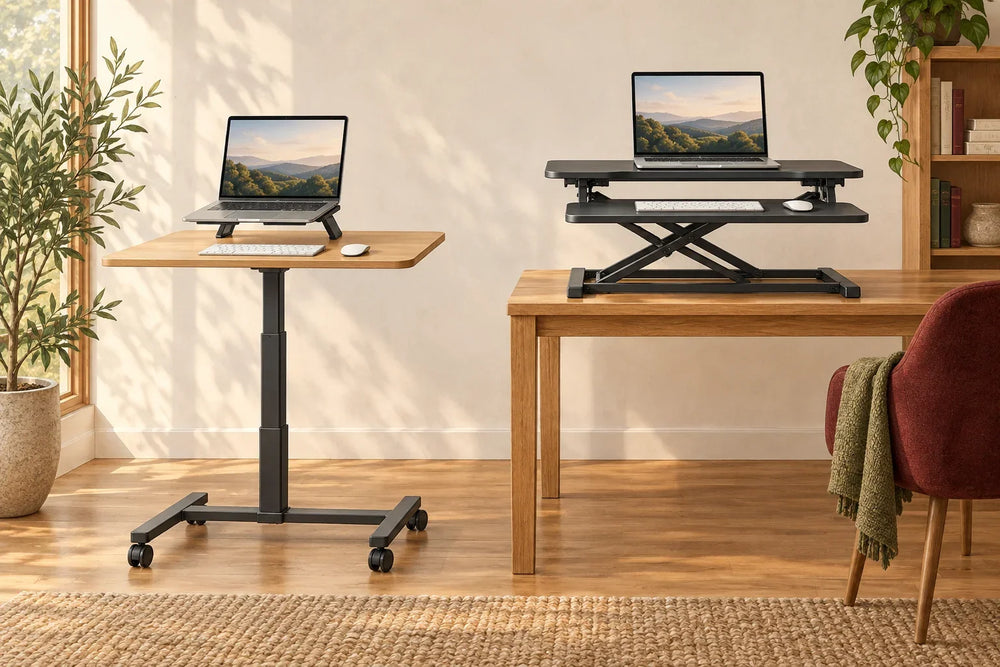
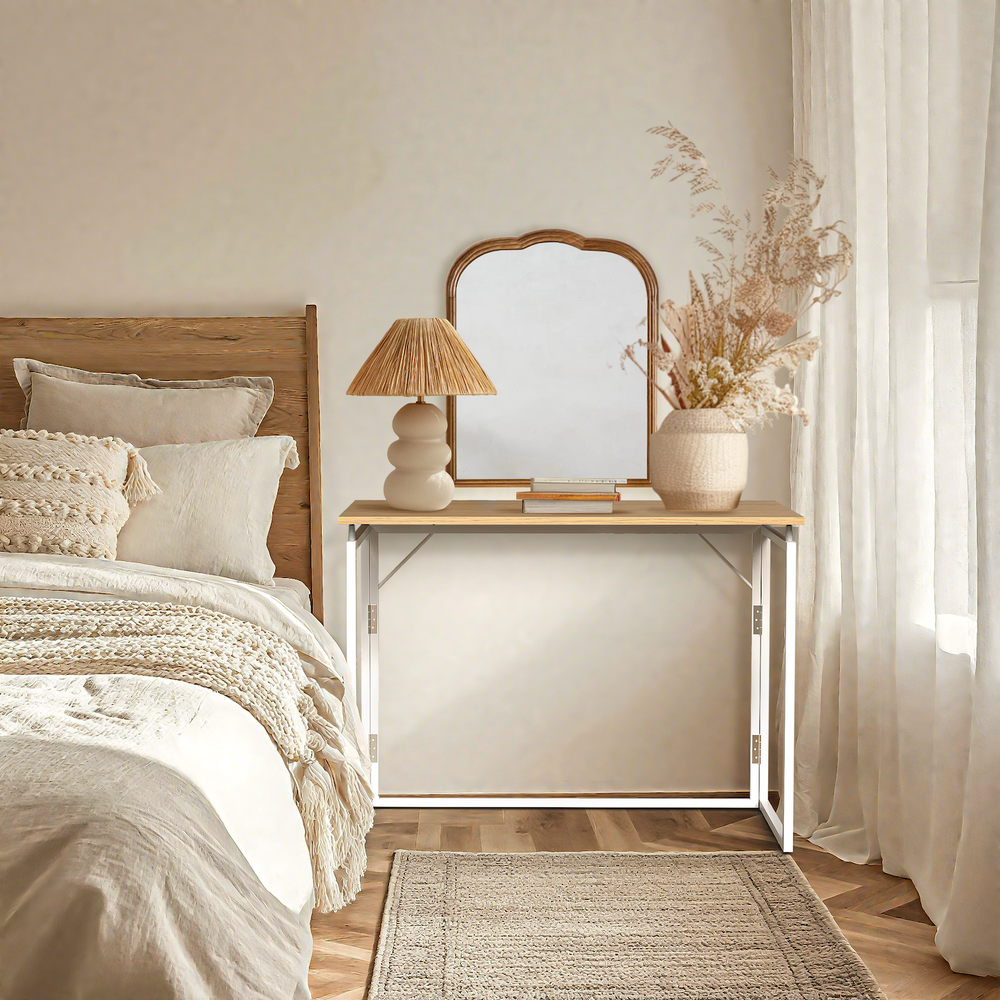
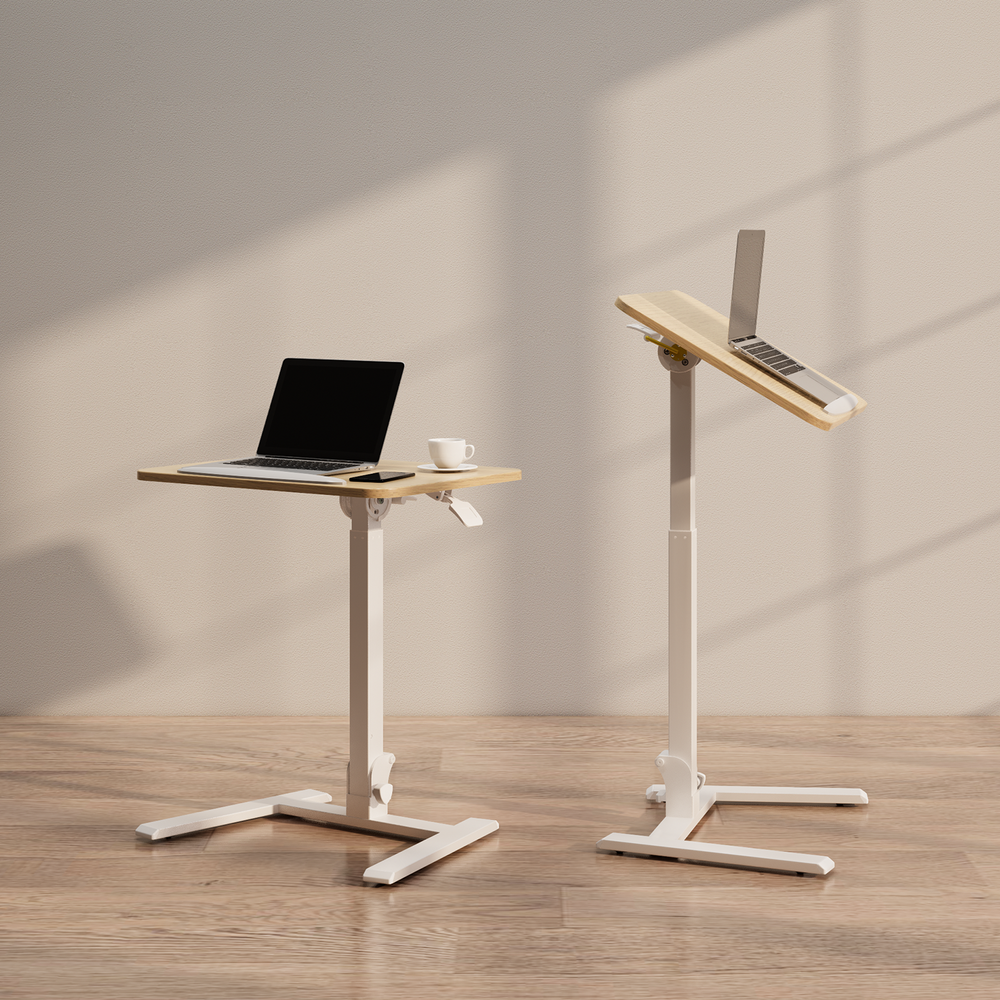
Cover: A freestanding folding desk can sit against a wall without becoming a wall-mounted desk. Brand styling illustration.
A folding desk and a wall-mounted desk can both help a small apartment do more with its available space. The better choice depends on where you can work comfortably, what you are allowed to install, and where everything goes when the workday ends.
Choose a freestanding folding desk if you want to avoid attaching a work surface to the wall, move between rooms, or put the desk away completely. Choose a wall-mounted fold-down desk if you have a suitable installation location and want the workstation to stay in one place. In either case, measure the space with the desk open and your chair occupied before you buy.
One distinction matters from the start: a wall-mounted desk may also fold. This guide compares a freestanding folding desk, supported by its own frame, with a wall-mounted desk attached to a wall.
Folding desk vs. wall-mounted desk at a glance
| What matters | Freestanding folding desk | Wall-mounted desk |
|---|---|---|
| Support | Stands on its own legs or frame. | Uses wall fixings; some designs also have a leg or other support. |
| Installation | Does not need wall mounting. Assembly requirements vary by model. | Needs installation suited to the product and wall construction. |
| Working position | Can be repositioned, subject to its size, weight, and instructions. | Stays in the installed location. |
| When closed | Still needs a storage position and a route to reach it. | Remains on the wall. A cabinet, brackets, or folded panel may still project into the room. |
| Equipment | Usually needs to be cleared before folding; follow the model's instructions. | May need to be cleared before closing. Only some units are designed to retain equipment. |
| Renting or moving | Can be useful where wall changes are restricted. | Requires checking installation permission and eventual removal. |
| Daily reset | Clear, fold, and place it in its storage position. | Clear or secure equipment as directed, then close the unit. |
1. Start with installation and your plans for the apartment
A freestanding folding desk is a useful starting point for renters who cannot install a wall-supported work surface. It also gives you more freedom to change the room later: the spot that works beside a window today may become a guest-bed area next month.
That flexibility has practical limits. Check the desk's weight, folded size, and handling instructions. A desk that can fold is not automatically easy for one person to carry, and “folding” does not always mean “no assembly required.”
A wall-mounted desk suits a more settled layout. Before choosing one, check the requirements for your wall, the mounting hardware, and the installation height. For example, IKEA's NORBERG assembly instructions explain that fasteners need to suit the wall material. Use the instructions for the particular product you buy; a fixing suitable for one wall or desk may not suit another.
If you rent, confirm that this type of installation is permitted before ordering. If you expect to move, include removal and any wall restoration in your decision. These details can matter more than the difference between two desktop finishes.
2. Compare the space you need while working
A desk that folds neatly may still be awkward to use. Measure three separate areas:
- The open desk footprint. Include the desktop, legs or base, support brackets, and any part that projects beyond the top.
- The chair in use. Sit in your actual chair, move back, and stand up. Check armrests, knee room, and where the chair goes afterward.
- The room's route. Walk to the door, bed, closet, and other regularly used furniture while the workstation is open.
A wall-mounted desk can reduce what remains in the room when closed, but it still needs working room when open. A freestanding desk may also fit under the same stretch of wall. Compare the complete setup rather than counting desk legs.

A worked example using hypothetical furniture
Imagine a 40-inch-wide wall area with 74 inches between the wall and a sofa. Your proposed desktop is 32 inches wide and 18 inches deep. Your occupied chair needs another 30 inches behind the front of the desk.
The depth calculation is 18 + 30 = 48 inches, leaving 74 − 48 = 26 inches before the sofa. That remainder only helps if it meets your household's actual circulation needs and no door, drawer, or chair movement crosses it.
If a wall-mounted desk has the same open depth and uses the same chair, the working-space calculation is similar. Its advantage appears after closing, when the top folds back toward the wall. The freestanding desk's advantage depends on having somewhere practical to store it.
These are illustrative measurements, not Alawooder product dimensions or a minimum-clearance recommendation. Mark your own layout with removable tape or cardboard, then try sitting, standing, and walking through it.
3. Make the desktop fit your equipment
List what you use at the same time. A laptop alone needs a different layout from a laptop, external keyboard, mouse, notebook, and monitor. Screen size is not the same as equipment footprint: the laptop body, monitor stand, cables, and accessories all take space.
Arrange those items on an existing table and measure the layout before choosing a smaller surface. Keep the keyboard and mouse usable without balancing them near an edge. Check the underside too; brackets, rails, and crossbars can affect where your knees and chair fit.
For a separate monitor, check viewing distance as well as desktop depth. OSHA's monitor guidance generally describes a preferred eye-to-screen distance of 20–40 inches. That is a viewing distance, not a rule that every desktop must be 20–40 inches deep; your seated position and the monitor's stand also affect the arrangement.
Neither desk type guarantees greater stability or a particular load capacity. Use the manufacturer's rating for the exact model and follow any conditions about load placement. A monitor arm adds concentrated forces at its clamp, so a general tabletop load rating alone does not confirm compatibility. Check the desk and arm requirements before fitting one.
4. Decide where the desk, chair, and accessories go afterward
Before choosing a folding desk for a small apartment, give the folded desk a specific home. “Behind the door” only works if its full folded width, height, and depth fit there without interfering with the door. “Under the bed” needs enough clear space for the whole desk and a usable route to slide it in.
Measure protruding hinges, feet, and other hardware, not just the desktop thickness. Follow the manufacturer's directions for the storage position. Our folding desk storage and moving-route guide explains how to check the destination and the route separately.
For a wall-mounted desk, check the closed projection and any clearance needed to open or latch it. A fold-down panel, cabinet desk, and fixed floating desk behave differently. Do not assume a unit can close with a laptop, monitor, lamp, or cables still inside unless it was designed for that arrangement.
The chair and accessories need a plan in both setups. If they stay in the walkway after the desktop closes, the room has not fully returned to its other use.

5. Try the daily reset before committing
The best space-saving setup is one you can return to its stored state without creating another pile elsewhere. Rehearse the routine with your existing equipment:
- Put the laptop, notebook, and small accessories in a designated bag, shelf, or drawer.
- Check where cables disconnect and where they stay. Keep them clear of moving joints and the route through the room.
- Consider the actions needed to fold or close the specific desk. Follow its instructions rather than assuming all mechanisms work the same way.
- Check whether you can handle the desk as intended and whether the storage route stays clear.
- Put the chair away, then open the door, closet, or guest bed you need to use.
Do not assume one type is always quicker. An accessible wall latch may suit a fixed work corner; a folding desk stored nearby may suit a room that changes purpose. A desk hidden behind several boxes can become inconvenient regardless of how compact it is.
Compare the complete cost too. For a freestanding desk, consider any assembly and storage needs. For a wall-mounted unit, consider the required hardware, installation help, and eventual removal. Avoid comparing only the price of the work surface.
Which setup fits the way you live?
A freestanding folding desk is a strong candidate when you need to keep the walls unchanged, work in more than one room, or remove the work surface from sight between sessions. It works best when its storage position is easy to reach and its open layout fits your equipment.
A wall-mounted desk is a strong candidate when you have a suitable wall, permission and a plan for installation, and a work position you want to keep. It works best when its open and closed shapes both suit the room and your chair has somewhere to go.
If the freestanding approach fits your needs, explore Alawooder's Folding Desk 30 Inch and Folding Desk 40 Inch. These model names identify the options; check the current product information for the measurements and setup details you need before ordering.
For the wider room layout, continue with our guide to planning a small home office with a folding desk, or browse the folding desk collection once you have your measurements.
Frequently asked questions
Is a wall-mounted desk better for a tiny apartment?
It can be, particularly if a fold-down design clears the work area after use. You still need a suitable wall, space to use it while open, and a place for the chair. Compare its closed projection with the space needed to store a freestanding folding desk.
Can renters use a wall-mounted desk?
That depends on the apartment's installation rules and the product's mounting requirements. Confirm permission and the wall conditions first. A freestanding folding desk can be an alternative when wall-supported furniture is unsuitable.
Are folding desks stable enough for everyday work?
They can be, but folding alone tells you little about stability. Check the specific frame, locking mechanism, surface, floor conditions, and manufacturer's load guidance. If you will use a monitor or arm, confirm those requirements separately.
Can I keep my monitor on the desk when I fold it?
Only if that particular desk is designed and instructed to close with the monitor in place. Otherwise, plan to remove and store the equipment first. A cabinet-style wall desk and a freestanding folding desk may have very different closing arrangements.
Will a folding desk fit under my bed?
Compare the complete folded dimensions with the clear space under your bed, including supports and any hardware that protrudes from the desk. Check the permitted storage position and the route into the space rather than relying on a “fold-flat” description.
What should I measure first?
Start with your equipment layout and the open workstation, including yourself in the chair. Then measure the storage position or closed wall unit. A desk needs to fit both parts of your day.